

Blog Post
HDPE vs ABS vs Aluminum: Why Plastic Wins for Impact Resistance
When sourcing protective storage cases, material selection plays a critical role. HDPE, ABS, and aluminum each offer distinct performance profiles; understanding these differences is key to making a durable, cost-effective choice for your production line.
What Sets These Materials Apart
Choosing the optimal material for protective cases requires looking beyond simple strength metrics to the fundamental chemical and physical structures of the materials themselves. The inherent differences between High-Density Polyethylene (HDPE), Acrylonitrile Butadiene Styrene (ABS), and Aluminum directly govern how each material reacts to stress, temperature extremes, and impact force.

These structural properties are the primary determinants of a case's ability to protect sensitive contents in varied operational environments.
Each material has a unique structure that shapes how it performs in real-world use.
- HDPE (High-Density Polyethylene). A semi-crystalline thermoplastic with high toughness. It flexes on impact rather than cracking or shattering. It also performs reliably in cold temperatures, maintaining strength down to -58°F.
- ABS (Acrylonitrile Butadiene Styrene). A rigid, amorphous plastic with solid impact resistance at room temperature. It holds its shape well under stress. However, it becomes more brittle in colder environments.
- Aluminum: A lightweight metal valued for structural strength. Aluminum cases are rigid and durable. The trade-off is that rigid materials tend to transfer force on impact rather than absorb it, which can affect the contents inside.
For OEMs building products used in the field or across varied environments, the difference between absorbing an impact and transferring it is significant.
The Real Test for Protective Storage Cases: Impact Resistance Under Pressure
Impact resistance is not just about strength. It's about how a material responds when force is applied.
ABS achieves strong results in standard testing, with some high-impact grades reaching over 500 J/m in Charpy impact tests. However, its performance drops in lower temperatures. HDPE, in contrast, maintains excellent impact strength even in extreme cold. Aluminum is structurally strong, but its rigidity means force moves through the material rather than being dispersed.
Plastic, especially HDPE, flexes slightly on impact. That flex is what disperses energy. The result is less force transferred to case contents.
Weight, Cost, and Practical Trade-Offs for OEMs
For OEMs making purchasing decisions at scale, performance is only part of the picture. Weight and cost are equally important factors.
- Weight. Aluminum cases are typically 30-50% heavier than comparable plastic cases. This adds up quickly in high-volume production contexts. Plastic cases offer meaningful weight reduction without sacrificing protection.
- Upfront cost. Aluminum cases often cost 50-150% more costly than plastic alternatives. For OEMs ordering in volume, that cost difference is substantial.
- Corrosion resistance. Both HDPE and ABS resist corrosion well. Aluminum can dent permanently over time.
- Custom tooling. Custom plastic cases, particularly blow-molded designs, can be produced at a fraction of the cost of custom aluminum tooling.
Why Blow-Molded Protective Storage Cases Work for OEMs
At The Plastic Forming Company (PFC), we specialize in high-performance, blow-molded carrying cases designed specifically for OEMs. Since inventing the double-wall case in the 1960s, we have refined a manufacturing process that prioritizes durability, cost-efficiency, and brand consistency.
The Double-Wall Advantage
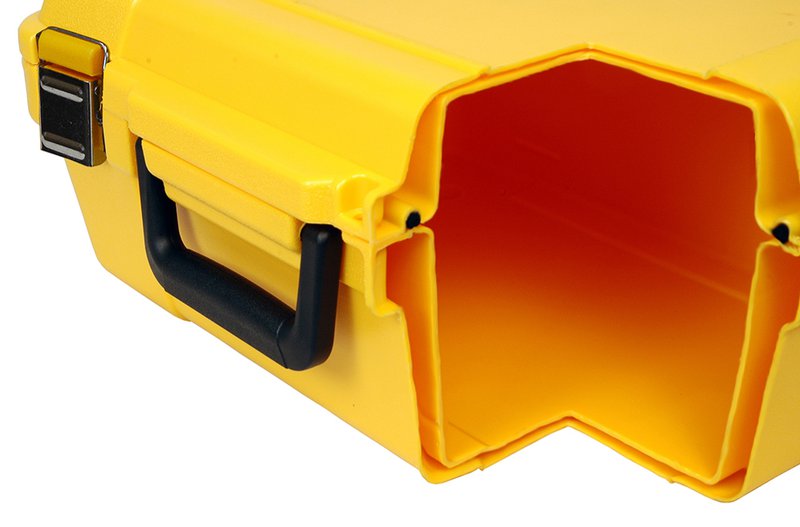
Our cases are engineered with a signature double-wall construction using recyclable High-Density Polyethylene (HDPE). This design creates an air-filled cushion that naturally absorbs and distributes impact forces, outperforming metal and single-wall alternatives in rigorous drop tests. The result is a structure that is exceptionally strong, lightweight, and resistant to chemicals, oils, and extreme temperatures.
Cost-Effective Customization
We believe custom protection shouldn't be cost-prohibitive. By utilizing our proprietary modular tooling system, we can develop a unique case tailored to your product while significantly reducing custom tooling costs. Beyond cost savings, our manufacturing process integrates specific design elements to meet your exact requirements:
- Integrated Molded Interiors: Unlike secondary inserts, our interiors are formed as a seamless part of the case itself, ensuring a precise fit and superior structural integrity.
- Layered Foam Solutions: For sensitive components, we offer custom-cut foam with multiple density layers to provide graduated shock absorption.
- Brand Integration: Enhance your product’s presentation with molded-in logos, custom colors, and high-quality digital labeling.
Build Smarter Protection Into Your Product Line
If impact resistance is a priority for your product line, material selection is the first decision to get right. Blow-molded plastic offers a compelling mix of toughness, weight efficiency, and cost-effectiveness.
PFC handles the entire production lifecycle in-house—from 3D part scanning and engineering to final production. Everything is proudly Made in the USA at our own facility, allowing strict quality control and swift lead times. Connect with us today. Our team is ready to help you find the right case solution.