

Uncategorized
Tolerance Engineering: Why Precision Matters for Equipment Fits
When it comes to protective storage cases, the fit of the interior is just as important as the strength of the exterior. A case that allows equipment to shift, even slightly, can lead to a pattern of small but serious damage over time. Tolerance engineering is the discipline that closes that gap.
For OEMs and product manufacturers, this topic goes far beyond aesthetics. The difference between a case that truly protects and one that merely holds a product comes down to how precisely the interior is engineered to accommodate each specific piece of equipment.
Understanding Tolerance Engineering for Protective Storage Cases
Tolerance engineering refers to the practice of defining allowable dimensional variation in manufactured components. In the context of a plastic case interior, it answers a simple but critical question: how much room is too much?

When mold tooling is designed, engineers must account for material behavior, wall thickness, draft angles, and cooling characteristics. Each factor influences how closely the finished interior matches the intended dimensions. A deviation of even a few millimeters can mean the difference between a snug, stable fit and one with unwanted play.
Tighter tolerances take more planning and expertise. They also require a manufacturing process with a high level of control throughout each production run.
The Hidden Cost of a Poor Fit
Most equipment damage during transportation does not happen from a single large impact. It accumulates. When an instrument shifts back and forth inside a case repeatedly, small contact points absorb force again and again. Over time, this micro-movement causes wear, loosened connections, or hairline fractures in sensitive components.
This is what makes a poor interior fit deceptive. The case can look undamaged on the outside while the equipment inside has been slowly degraded. The damage only becomes visible when a calibrated instrument starts giving inaccurate readings, or a precision tool begins to fail.
A proper fit eliminates the conditions that allow this kind of deterioration to occur. There is no room to rattle, so there is nothing to cause wear.
How Mold Design Controls the Fit of Protective Storage Cases
The interior of a well-designed case is not passive. It is shaped to mirror the specific contours of the equipment it holds. This requires precise mold engineering at every stage:
- Cavity geometry. Each compartment is designed to match the exact profile of the item it will hold, with controlled clearances that keep the equipment seated without forcing it in
- Wall consistency. Uniform wall thickness across the interior ensures that contact pressure is evenly distributed, preventing concentrated stress points on the equipment
- Material behavior:. Blow-molded plastic has a slightly flexible character, which works in the product's favor. It accommodates minor variances while still holding the equipment securely in place
- Draft and release angles. Proper draft engineering ensures the interior releases cleanly from the mold, preserving the dimensional accuracy of every cavity
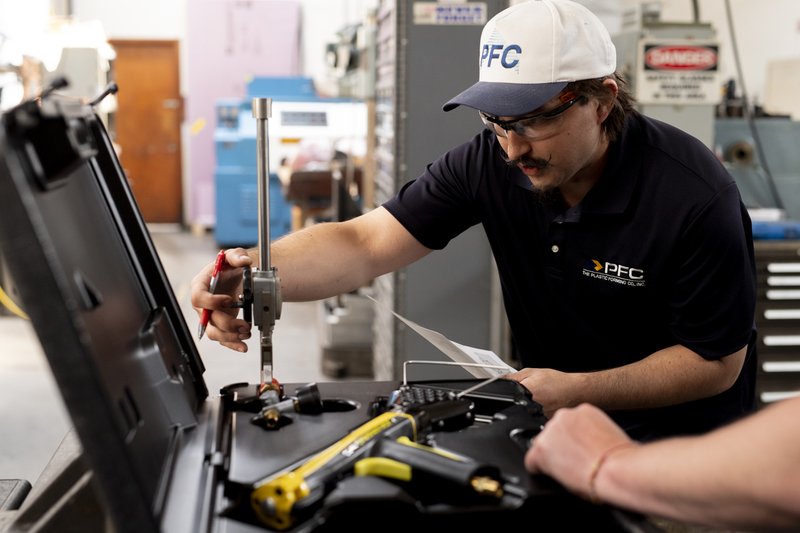
When these factors are carefully managed, the resulting interior holds equipment firmly and consistently across every unit in a production run.
Why Integrated Interiors Outperform Add-On Solutions
One important distinction is whether the interior is integrated into the case itself or added after the fact. An aftermarket insert, placed inside a generic shell, introduces its own dimensional variables. The insert may shift within the case, and its fit relative to the equipment depends on the tolerances of two separate components rather than one unified design.
An integrated interior eliminates that compounding effect. When the interior is formed as part of the case itself, the entire system is designed and built to a single set of specifications. There is no secondary component to drift, compress unevenly, or lose its shape over time. The result is a more stable and more repeatable fit across thousands of units.
This is especially valuable for OEMs producing equipment that requires consistent protection run after run.
Build the Right Fit for Your Equipment
Precision fit is not something that happens by chance. It requires deliberate engineering, controlled manufacturing, and a deep understanding of how materials behave during the molding process. That is exactly what we do at The Plastic Forming Company.
Our custom molded interiors are not inserts. They are formed as part of the case itself during the blow molding process, which means the interior geometry is built to your equipment's exact specifications from the start. We handle everything in-house, including design, mold engineering, and manufacturing, all in the USA.
We also offer layered foam interiors with multiple density layers for graduated protection, for applications where a molded interior is not the right solution. Whether your product needs a snug molded cradle or a cushioned foam environment, we can engineer an interior that eliminates unwanted movement and protects your equipment in transit and in the field.
If you want to discuss how a precision-fit interior can reduce equipment wear for your product line, send us a message today. We would be glad to walk through what the right solution looks like for your specific application.